
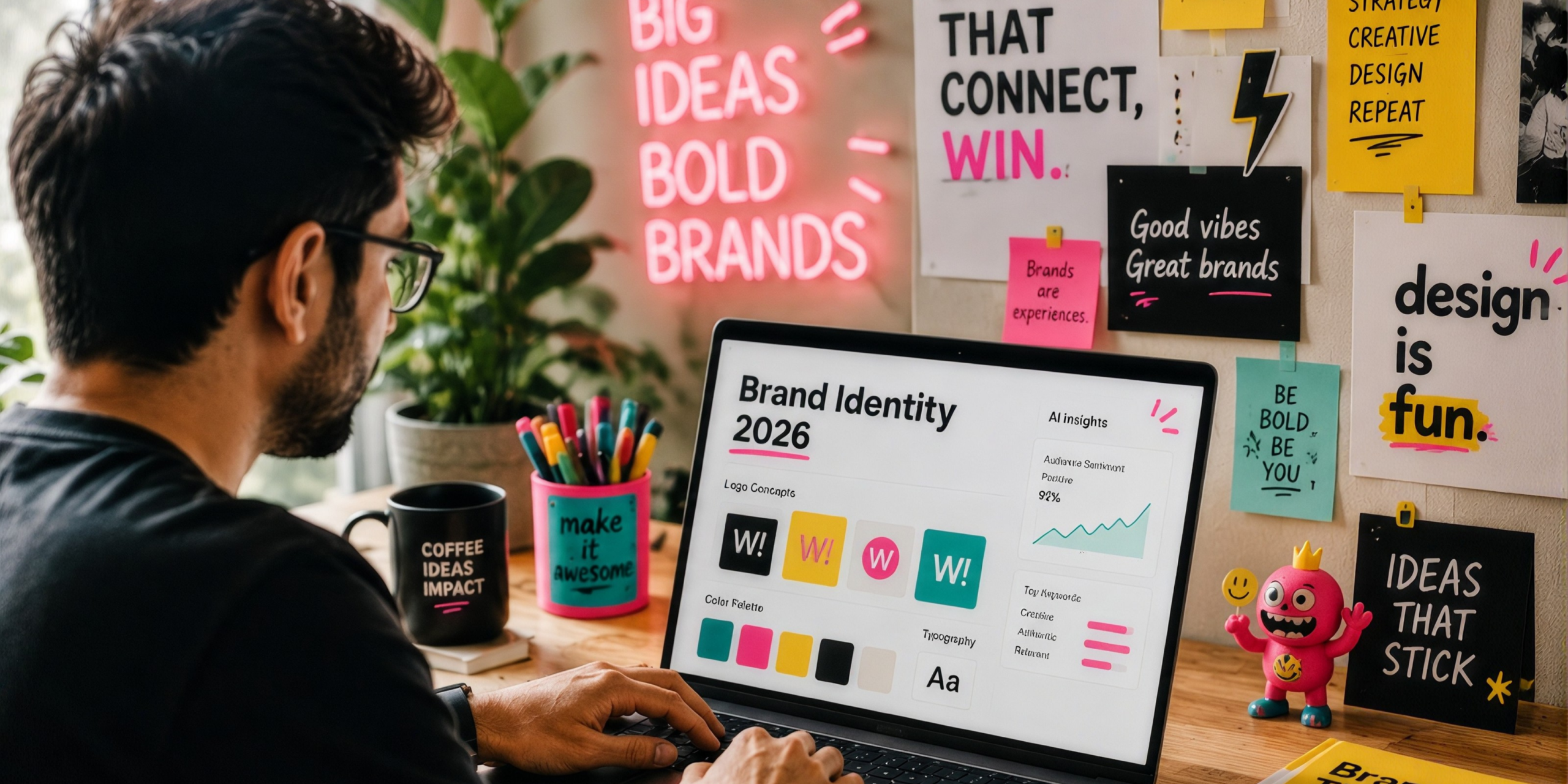
Whether you are a branding agency in Pune or a company ready to reach out to customers, building a brand identity is still as important as ever. But in 2026, how a brand builds their identity and communicates with their customers has drastically changed. Gone are the days of static logos, simple packaging, and one-way communication doing the job. Today, building a brand identity for Indian businesses in 2026 is more sophisticated than ever before. Let us take a look into how it has changed and what 2026 brings for marketers.
What Is Brand Identity?
First of all, let us dive into what brand identity is.
You have three bottles of water, each with a label. The labels say Aquafina, Evian, and Bisleri. Without the labels, the three bottles seem the same. As soon as you put on the labels – each bottle transforms.
This is because each of these labels – these brands – has something called brand identity. That is the tangible and intangible qualities of a brand that helps people relate to them. Brand identity can include logo, packaging design, colours, as well as brand voice, values, and personality. It can also include a brand’s mission and vision, culture, and the language they use to communicate with their customers.
Brand identity helps customers differentiate products. It also creates brand recognition and loyalty. No two products have the exact same brand identity. So it is important that a company pays a lot of thoughtful attention to their brand so that they craft a truly unique identity that resonates deeply with their target audience.
Brand Identity for Indian Business 2026
In 2026, it is even more important for companies to invest time and energy into creating their brand identity. Businesses must shift from static branding to purpose-driven adaptive systems that prioritise authenticity and AI-generated experiences. Technology is changing the way people discover, evaluate, and interact with companies. Brands must now act as living systems and evolve with the times. Here are a few pointers on what brands will be doing differently in 2026.
1) Using AI in Their Brand Strategy
AI is now a part of every stage of branding. That includes market research, to content creation, to customer service. Companies use AI tools to:
● Create customised and personalised brand messaging
● Assess customer behaviour
● Automate brand voice
● Create adaptive identities
Therefore, AI will not replace brand strategy but will strengthen and amplify it. The best way forward is to combine machine intelligence with human insight and ethical oversight.
2) Hyper Personalisation
Customers want brands to understand them and adapt to their behaviour. Platforms such as Netflix and Amazon are leaders in this domain. In 2026, this will extend across industries – from financial services to healthcare.
Modern branding now wants dynamic websites that adapt to user behaviour, real-time email campaigns, customised product recommendations, and location-sensitive experiences.
3) Brands As Community
We live in an era of social media which has created strong communities around brands. Brands that are able to capitalise on authenticity and participation can create a much desired collaborative environment.
4) Purpose-Driven Positioning
Today’s customer wants their brands to have a purpose. That can be sustainability driven branding, and a lot more. Purpose is now tied with performance metrics.
5) Immersive and Spatial Branding
Extended reality, augmented reality, and spatial computing have led to the formation of multi-sensory digital experiences. In 2026, branding includes virtual show-rooms, AI product try-ons, interactive brand worlds, and mixed-reality.
6) Creator-Led Brand Growth
Unless you have been living under a rock, you must have noticed the incredible boom in the creator economy. Brands are investing in co-branded content, micro-influencers are outperforming celebrity endorsements, and the creator economy is booming.
7) Trust Is The Ultimate Currency
We’ll go into this again later but in the age of AI, there is a lot of misinformation due to AI generated content. Ways to build trust include verifiable brand communication, disclosure policies and real-time transparency in times of crisis.
8) The Rise of Living Systems
In 2026, brands operate with dynamic design systems, modular brand assets, continuous feedback loops, and brand identity is treated as an ever-evolving framework that stays recognisable.
What Indian Businesses Need To Do Differently Now
With all these changes, Indian businesses need to step up their game. They need to shift from polished and generic marketing to purpose-driven, human centric branding to cut through intense AI-generated noise. Authentic identity is now important because it builds trust and drives visibility. Consumers today reward brands that have strong E-E-A-T (Experience – Expertise – Authoritativeness -Trustworthiness) and personal employee voices over automated content.
E-E-A-T in Brand Identity
This framework is used by Google’s search quality raters to assess content quality. In branding, it means creating a reputation as a credible, transparent, and expert entity crucial for high-stakes topics to create customer trust and high SEO visibility.
Employee Advocacy
Both the algorithm and the consumer trust real-life people, such as employees, over anything AI. Content showcasing real experience outweighs generic content created by AI.
AI Generated Noise
The advent of AI has created pathways for more people than ever to be able to create content. This has caused a massive saturation and audience fatigue. Indian audiences want human touch over robotic interactions and authentic branding has become crucial to build loyalty.
Why Authentic Brands Matter More in 2026
Like in the example of the water bottles, brand identity is an authentic personality donned by a brand. It creates a connection with people from the very first time they see your product. In the age of AI and social media, it has become more important than ever for brands to be authentic, genuine, and real with their customers.
This is the only way that brands can differentiate themselves and stand out from a cluttered industry. It is also the only way they can connect and communicate with their target audience in a way that is fruitful and productive for both brand and customer. 2026 is the year of authentic branding, powered by technology – and that is here to stay.
Team up with us at White Warbler Communications today and take your brand identity to the next level. Together, we can craft a brand identity that resonates with your target audience.
FAQs
What Are Brand Identity Trends in 2026?
In 2026, brands must be authentic and express E-E-A-T in their specific domains. There are also other brand identity trends, such as using AI in brand strategy, hyper personalisation, building communities around brands, purpose-driven positioning, immersive and spatial branding, creator-led brand growth, building trust as currency, and the rise of living systems. Branding agencies such as White Warbler Communications can help brands stay on trend when it comes to their branding.
What is Brand Strategy in 2026?
In 2026, brand strategy is AI-native and purpose driven. It focuses on hyper-personalisation, community building, and an ethical and transparent physical and digital experience. Rather than a static plan, it acts as a living system. Brands integrate AI to predict customer behaviour while prioritizing human-centric storytelling. Key strategies include community-led growth, and voice search optimization.